
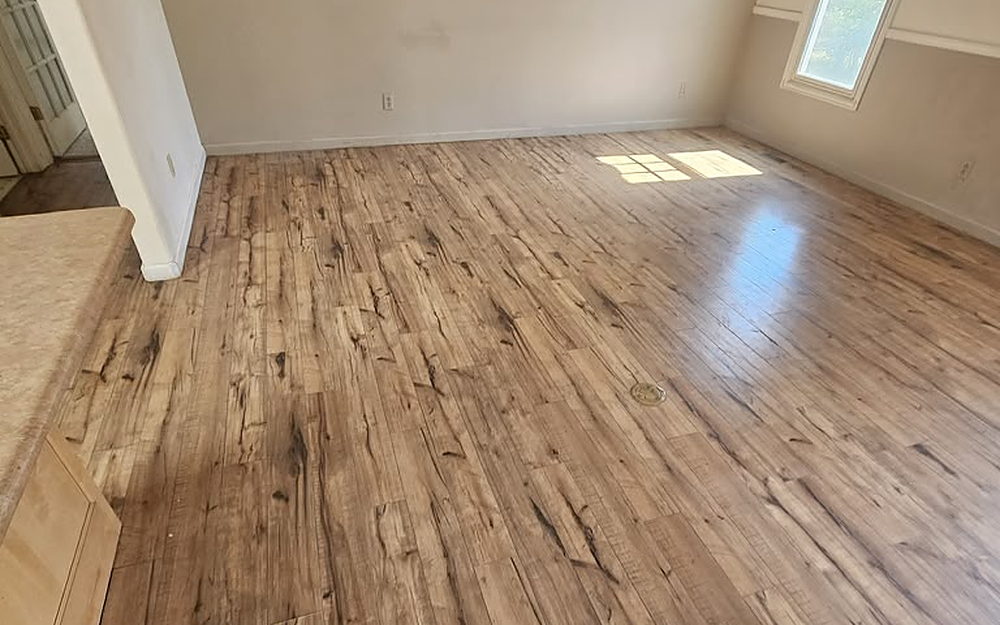
From November to April, the most destructive thing entering a Minnesota home is not mud. It is the grit and chloride mix from the roads, riding in on boots and settling into the first eight feet of every entry. It does two kinds of damage simultaneously, which is why it is so much worse than ordinary dirt.
The first is mechanical. Salt and sand crystals are hard and angular, and every step grinds them against the floor finish like sandpaper. The second is chemical: chlorides attract and hold moisture, keeping a damp, mineral-laden film sitting on the surface for hours. Neither is dramatic on any single day, and together they account for most of the entry-floor wear we see in the towns we serve.
What salt actually does to a floor
The abrasive part is easy to underestimate because the scratches start microscopic. Thousands of them, concentrated in a traffic lane, dull the finish rather than mark it. That is why an entry floor loses its sheen in a stripe before anything looks obviously scratched, and why the solution is removal rather than polishing.
The chemical part is what leaves the white bloom. Chlorides are hygroscopic — they pull moisture from the air — so a dried salt film is not inert. It stays slightly damp, holds that moisture against the finish, and on hardwood can work into seams and cause the edges of boards to swell over a season.
On grout and unglazed tile the residue soaks in, and once it is in the pore structure it keeps attracting new dirt. This is the mechanism behind a floor that looks dirty again two hours after being mopped: the salt was never removed, only redistributed.

Why the white haze keeps coming back
Plain water and standard neutral cleaner dissolve salt but do not neutralize it, and a mop bucket quickly becomes salt water that gets spread across the room. The film dries, draws moisture from the air, and the haze reappears within a day.
The method that works is sequential. Vacuum or dry-mop first to remove every loose crystal, because wet-mopping over grit is how you scratch a floor while cleaning it. Then use a neutralizing cleaner formulated for ice-melt residue, which converts the chloride rather than just diluting it. Then rinse with clean water and change the water often — this step is the one people skip, and it is the one that matters.
Vinegar deserves a specific warning here, because it circulates as a universal remedy. It is acidic, and on natural stone, marble, travertine and unsealed grout it etches. On polyurethane hardwood finishes, repeated use dulls the surface. It is the wrong tool for winter floors.
The entry setup that prevents most of it
Cleaning is damage control. Preventing salt from reaching the floor at all is what actually protects it, and it costs very little.
- Two mats, not one: a coarse scraper outside the door and an absorbent runner inside.
- Long enough for several full steps — a small square in front of the door catches almost nothing.
- A boot tray with a raised edge, so meltwater collects instead of spreading across the floor.
- A bench or chair, because people remove boots when it is easy and walk through when it is not.
- Vacuum the mats twice a week; a saturated mat stops working and starts holding salt against the floor.
- In a garage entry, keep a broom by the door and sweep the threshold — most of the grit is already loose there.
Households that adopt the two-mat setup notice the difference by January. It is the highest return on effort available in a Minnesota winter.
How to clean salt without making it worse
The order matters more than the product, and getting it wrong causes most of the winter damage we are called about.
- Dry first, always. Vacuum or dry-mop the entire salted area before any liquid touches it.
- Use minimal moisture on wood and laminate. A microfiber mop should be damp, never wet.
- Change water frequently. Salty mop water spreads the problem into rooms that were clean.
- Use a neutralizer on tile, LVP and sealed concrete, then rinse with clean water.
- Avoid vinegar and other acids on stone, marble and unsealed grout.
- Dry the entry after cleaning, because standing meltwater is what reaches seams and subfloor.
Frequency beats intensity all winter. Twice-weekly attention to the first eight feet does more good than one aggressive whole-floor cleaning in March, by which point the abrasion has already happened.
Hardwood, LVP and tile each fail differently
Knowing your floor's failure mode tells you where to spend the effort.
- Hardwood and engineered wood: finish dulls in lanes, seams swell where water sits. Minimum moisture, dry immediately.
- LVP and laminate: tolerant of traffic, but residue builds into a haze and the edges of planks can lift with standing water.
- Ceramic and porcelain tile: the tile is fine; the grout absorbs and holds salt, then keeps attracting dirt.
- Natural stone: the most vulnerable of all — abrasive scratching plus etching from any acidic product.
- Carpet at the entry: salt crystals settle to the base of the pile and grind at the fibers with every step.
Carpet at an entry needs vacuuming far more often in winter than the rest of the house, and it usually benefits from extraction once the season ends.
What to do in spring
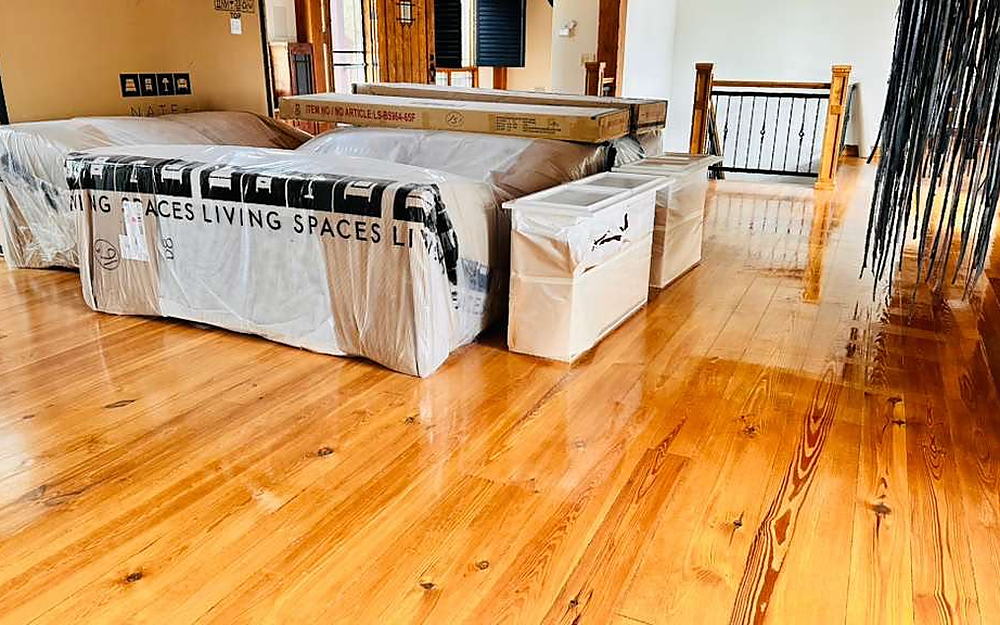
When the salt trucks stop, the season needs a proper close. A neutralizing wash across all hard floors, a full rinse, and grout brushed in entry areas removes the residue that has accumulated since November rather than leaving it to draw moisture through the summer.
It is also the moment to assess honestly what the winter cost you. Look at the entry floor at a low angle in daylight: if the finish is dull only in the traffic lane, that is abrasion, and on hardwood a screen-and-recoat is far cheaper than a full sanding — but only while the wear is in the finish rather than in the wood.
Retire the mats that are matted flat. A runner that has stopped absorbing is not saving your floor; it is holding salt against it.
Where a cleaning service fits
A recurring plan through winter is largely about the entry. On a biweekly rhythm the first eight feet get consistent attention, mats get vacuumed, and the salt film gets neutralized before it has time to grind or bloom.
In between visits the useful habits are small: sweep the threshold, empty the boot tray, keep a microfiber mop by the door. None of it takes more than a minute at a time, and it is what keeps the floor you already paid for.
For homes in Wyoming, Stacy, Scandia and the rural properties where gravel dust joins the salt, a spring reset clean is worth putting on the calendar in advance. It is the single most useful cleaning visit of the year here.